


Mar 29, 2026 Updated DY0-001 Dumps Questions For CompTIA Exam
Best Value Available Preparation Guide for DY0-001 Exam
NEW QUESTION # 16
Given matrix
Which of the following is AT?
- A.

- B.

- C.

- D.

Answer: D
Explanation:
Transposing swaps rows and columns, so the (i, j) entry becomes the (j, i) entry.
NEW QUESTION # 17
Which of the following types of machine learning is a GPU most commonly used for?
- A. Natural language processing
- B. Deep learning/neural networks
- C. Tree-based
- D. Clustering
Answer: B
Explanation:
GPUs excel at the massive parallelism required for the matrix and tensor operations at the heart of deep neural network training and inference, making them the go-to hardware for deep learning workloads.
NEW QUESTION # 18
A movie production company would like to find the actors appearing in its top movies using data from the tables below. The resulting data must show all movies in Table 1, enriched with actors listed in Table 2.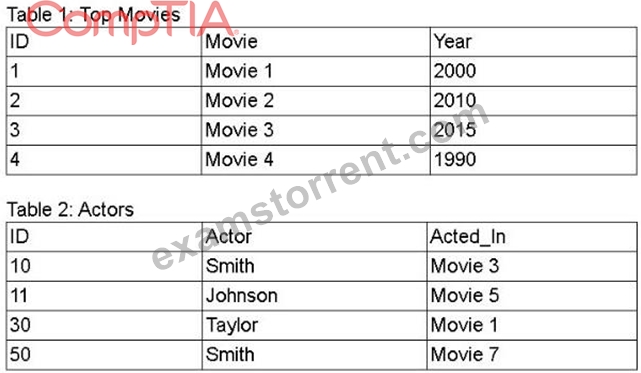
Which of the following query operations achieves the desired data set?
- A. Perform a LEFT JOIN on Table 1 using column Movie, with Table 2 using column Acted_In.
- B. Perform an INTERSECT between Table 1 using column Movie, and Table 2 using column Acted_In.
- C. Perform an INNER JOIN between Table 1 using column Movie, and Table 2 using column Acted_In.
- D. Perform a UNION between Table 1 using column Movie, and Table 2 using column Acted_In.
Answer: A
Explanation:
# A LEFT JOIN ensures all rows from Table 1 (Top Movies) are preserved, even if there's no matching actor data in Table 2. This matches the requirement to show all movies, enriched with actor information when available.
Why the other options are incorrect:
* A: INNER JOIN would exclude movies without matching actor entries.
* B: UNION combines distinct rows - not appropriate for matching columns between two tables.
* C: INTERSECT shows only common movies - excludes unmatched top movies.
Official References:
* CompTIA DataX (DY0-001) Study Guide - Section 5.2:"LEFT JOINs are used when all records from one table (primary) must be retained, even if there are no matching rows in the secondary table."
-
NEW QUESTION # 19
Which of the following environmental changes is most likely to resolve a memory constraint error when running a complex model using distributed computing?
- A. Migrating to a cloud deployment
- B. Adding nodes to a cluster deployment
- C. Moving model processing to an edge deployment
- D. Converting an on-premises deployment to a containerized deployment
Answer: B
Explanation:
When running a model on a distributed system, encountering memory constraint errors indicates that the current nodes in the cluster do not have enough memory to handle the model. The most scalable and immediate solution is:
# Adding Nodes to a Cluster Deployment - This increases the total available memory and compute power. In distributed computing environments like Apache Spark or Hadoop, horizontal scaling via node addition is a standard remedy for resource bottlenecks, including memory limitations.
Why the other options are incorrect:
* A. Containerizing doesn't inherently solve memory issues unless paired with resource upgrades.
* B. Cloud migration may offer more resources, but without scaling configuration, memory limits may persist.
* C. Edge deployment is for low-latency, local processing - often with less memory, not more.
Official References:
* CompTIA DataX (DY0-001) Official Study Guide - Section 5.2 (Infrastructure & Scaling):"To resolve memory limitations in distributed systems, scaling out by adding nodes is the most direct and cost- effective method."
* Data Engineering Fundamentals (Cloud/Distributed Systems):"Cluster resource constraints (e.g., memory) can be mitigated by increasing node count, enabling parallel execution and expanded memory pools."
-
NEW QUESTION # 20
A data scientist has built an image recognition model that distinguishes cars from trucks. The data scientist now wants to measure the rate at which the model correctly identifies a car as a car versus when it misidentifies a truck as a car. Which of the following would best convey this information?
- A. AUC/ROC curve
- B. Box plot
- C. Confusion matrix
- D. Correlation plot
Answer: C
Explanation:
# A confusion matrix gives a detailed view of a classification model's performance, including true positives, false positives, true negatives, and false negatives. It's the best tool for examining model accuracy and misclassification between specific classes - like mislabeling trucks as cars.
Why the other options are incorrect:
* B: AUC/ROC gives a broader performance summary but not individual class misclassifications.
* C: Box plots show distributions, not classification accuracy.
* D: Correlation plots show relationships between variables - not confusion results.
Official References:
* CompTIA DataX (DY0-001) Study Guide - Section 4.3:"Confusion matrices enable detailed analysis of classification performance and misclassification rates."
* Machine Learning Textbook, Chapter 5:"For evaluating how models classify specific classes, confusion matrices are the most direct and interpretable tool."
-
NEW QUESTION # 21
A data scientist is deploying a model that needs to be accessed by multiple departments with minimal development effort by the departments. Which of the following APIs would be best for the data scientist to use?
- A. JSON
- B. REST
- C. RPC
- D. SOAP
Answer: B
Explanation:
RESTful APIs use standard HTTP methods and lightweight data formats (typically JSON), making them easy for diverse teams to integrate with minimal effort and without heavy tooling.
NEW QUESTION # 22
Which of the following compute delivery models allows packaging of only critical dependencies while developing a reusable asset?
- A. Thin clients
- B. Edge devices
- C. Containers
- D. Virtual machines
Answer: C
Explanation:
Containers encapsulate just the application and its critical dependencies on a lightweight runtime, making the resulting asset portable and reusable without bundling an entire operating system.
NEW QUESTION # 23
A data scientist is developing a model to predict the outcome of a vote for a national mascot. The choice is between tigers and lions. The full data set represents feedback from individuals representing 17 professions and 12 different locations. The following rank aggregation represents 80% of the data set: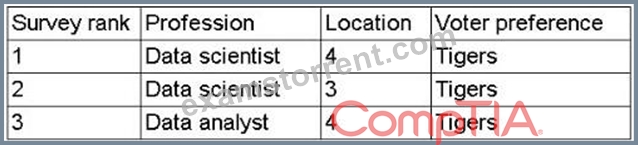
(Screenshot shows survey rankings for just two professions and a few locations, all voting for "Tigers") Which of the following is the most likely concern about the model's ability to predict the outcome of the vote?
- A. Out-of-sample data
- B. In-sample data
- C. Extrapolated data
- D. Interpolated data
Answer: C
Explanation:
# Extrapolated data refers to making predictions about data points that fall outside the observed range or distribution. Since the sample data (80%) is heavily skewed toward a small subset of professions and locations, predicting results for the remaining, unrepresented professions and regions involves extrapolation.
Why the other options are incorrect:
* A: Interpolation occurs within the bounds of observed data - not the issue here.
* C: In-sample data refers to training data, which is overrepresented in this case.
* D: Out-of-sample data is a concern in generalization but extrapolation is more specific here.
Official References:
* CompTIA DataX (DY0-001) Study Guide - Section 3.2:"Extrapolation introduces risk when models are used outside the range of data they were trained on, especially if certain subgroups are underrepresented."
-
NEW QUESTION # 24
Which of the following explains back propagation?
- A. The passage of convolutions backward through a neural network to update weights and biases
- B. The passage of nodes backward through a neural network to update weights and biases
- C. The passage of errors backward through a neural network to update weights and biases
- D. The passage of accuracy backward through a neural network to update weights and biases
Answer: C
Explanation:
# Backpropagation (short for "backward propagation of errors") is the fundamental algorithm for training neural networks. It involves computing the error at the output and propagating it backward through the network to update weights and biases via gradient descent.
Why the other options are incorrect:
* A: Convolutions are specific to CNNs and are not propagated in this manner.
* B: Accuracy is an evaluation metric, not used in weight updates.
* C: Nodes are structural elements, not passed backward.
Official References:
* CompTIA DataX (DY0-001) Official Study Guide - Section 4.3:"Backpropagation passes the error backward from the output layer to the input layer to adjust weights using gradient-based optimization."
* Deep Learning Textbook, Chapter 6:"The backpropagation algorithm is essential for computing gradients of the loss function with respect to each weight."
-
NEW QUESTION # 25
An analyst is examining data from an array of temperature sensors and sees that one sensor consistently returns values that are much higher than the values from the other sensors. Which of the following terms best describes this type of error?
- A. Idiosyncratic
- B. Heteroskedastic
- C. Systematic
- D. Synthetic
Answer: C
Explanation:
A sensor that consistently reads higher than the others exhibits a repeatable bias, which is characteristic of a systematic error.
NEW QUESTION # 26
Which of the following is a key difference between KNN and k-means machine-learning techniques?
- A. KNN is used for classification, while k-means is used for clustering.
- B. KNN performs better with longitudinal data sets, while k-means performs better with survey data sets.
- C. KNN operates exclusively on continuous data, while k-means can work with both continuous and categorical data.
- D. KNN is used for finding centroids, while k-means is used for finding nearest neighbors.
Answer: A
Explanation:
# K-Nearest Neighbors (KNN) is a supervised machine learning algorithm used primarily for classification and regression. It labels a new instance by majority vote (or averaging, in regression) of its k-nearest labeled neighbors.
# k-Means is an unsupervised learning algorithm used for clustering. It partitions unlabeled data into k groups based on feature similarity, using centroids.
Thus, the key difference is in their purpose:
* KNN # Classification (Supervised)
* K-Means # Clustering (Unsupervised)
Why the other options are incorrect:
* A: Both can technically operate on continuous or categorical data (with preprocessing).
* B: This is not a meaningful or standardized distinction.
* C: This reverses the actual roles. k-means finds centroids; KNN finds nearest neighbors.
Official References:
* CompTIA DataX (DY0-001) Official Study Guide - Section 4.1 (Classification vs. Clustering):"KNN is a supervised learning algorithm for classification tasks. K-means is an unsupervised clustering technique that groups data by proximity to centroids."
* Data Science Handbook, Chapter 5:"One key distinction: KNN uses labeled data to classify or regress; k-means uses unlabeled data to identify groupings."
-
NEW QUESTION # 27
A data scientist built several models that perform about the same but vary in the number of features. Which of the following models should the data scientist recommend for production according to Occam's razor?
- A. The model with the fewest features and highest performance
- B. The model with the most features and the lowest performance
- C. The model with the most features and the highest performance
- D. The model with the fewest features and the lowest performance
Answer: A
Explanation:
According to Occam's razor, when models perform equivalently, you choose the simplest one - in this case, the model that achieves the needed performance with the fewest features.
NEW QUESTION # 28
A data analyst wants to find the latitude and longitude of a mailing address. Which of the following is the best method to use?
- A. Geocoding
- B. One-hot encoding
- C. Binning
- D. Imputing
Answer: A
Explanation:
# Geocoding is the process of converting addresses (like "1600 Amphitheatre Parkway, Mountain View, CA") into geographic coordinates (latitude and longitude), which is essential for spatial data analysis and mapping.
Why other options are incorrect:
* A: One-hot encoding is for converting categorical variables into binary vectors.
* B: Binning is for grouping continuous variables into categories.
* D: Imputing fills in missing data values, unrelated to geographic location retrieval.
Official References:
* CompTIA DataX (DY0-001) Study Guide - Section 6.3:"Geocoding is a technique to convert textual location data into coordinate-based data for geographic analysis."
-
NEW QUESTION # 29
A data scientist is building a proof of concept for a commercialized machine-learning model. Which of the following is the best starting point?
- A. Hyperparameter tuning
- B. Model performance evaluation
- C. Model selection
- D. Literature review
Answer: D
Explanation:
Before diving into selecting or tuning models, a literature review grounds the proof of concept in existing research and best practices, ensuring the approach aligns with state-of-the-art methods and the problem's domain requirements.
NEW QUESTION # 30
A data scientist is creating a responsive model that will update a product's daily pricing based on the previous day's sales volume. Which of the following resource constraints is the data scientist's greatest concern?
- A. Data collection time
- B. Development time
- C. Training time
- D. Deployment time
Answer: C
Explanation:
Because the model must be retrained every day on yesterday's sales data to set today's prices, the time it takes to train the model becomes the critical bottleneck in a responsive, daily‐update workflow.
NEW QUESTION # 31
An analyst wants to show how the component pieces of a company's business units contribute to the company's overall revenue. Which of the following should the analyst use to best demonstrate this breakdown?
- A. Scatter plot matrix
- B. Residual chart
- C. Sankey diagram
- D. Box-and-whisker chart
Answer: C
Explanation:
A Sankey diagram visualizes flows from individual business units into the total, with the width of each flow proportional to its revenue contribution, making it ideal for showing how each component feeds the overall total.
NEW QUESTION # 32
A data analyst is analyzing data and would like to build conceptual associations. Which of the following is the best way to accomplish this task?
- A. TF-IDF
- B. n-grams
- C. NER
- D. POS
Answer: B
Explanation:
n-grams capture contiguous sequences of words, revealing which terms co-occur and form meaningful multi-word concepts. By analyzing these frequent word combinations, you directly uncover conceptual associations in the text.
NEW QUESTION # 33
Which of the following describes the appropriate use case for PCA?
- A. Regression
- B. Dimensionality reduction
- C. Recommendation
- D. Classification
Answer: B
Explanation:
Principal Component Analysis transforms correlated features into a smaller set of uncorrelated components that capture most of the variance, making it ideal for reducing dimensionality before modeling or visualization.
NEW QUESTION # 34
A computer vision model is trained to identify cats on a training set that is composed of both cat and dog images. The model predicts a picture of a cat is a dog. Which of the following describes this error?
- A. False positive error
- B. Sampling error
- C. Error due to reality
- D. Type II error
Answer: D
Explanation:
# A Type II error occurs when the model fails to identify a positive instance - in this case, a cat. That is, it incorrectly classifies a cat (positive class) as a dog (negative class). This is also referred to as a false negative.
Why the other options are incorrect:
* A: "Error due to reality" is not a recognized statistical concept.
* B: A false positive would mean misclassifying a dog as a cat (opposite error).
* C: Sampling error refers to discrepancies between the sample and population, not a misclassification.
Official References:
* CompTIA DataX (DY0-001) Official Study Guide - Section 1.5:"Type II errors occur when a model incorrectly identifies a true positive as a negative - also known as a false negative."
* Pattern Recognition and Machine Learning, Chapter 9:"In binary classification, a Type II error means failing to detect a positive class instance, leading to a false negative result."
NEW QUESTION # 35
......
CompTIA DY0-001 Exam Syllabus Topics:
| Topic | Details |
|---|---|
| Topic 1 |
|
| Topic 2 |
|
| Topic 3 |
|
| Topic 4 |
|
| Topic 5 |
|
Full DY0-001 Practice Test and 85 Unique Questions, Get it Now!: https://pass4sure.examstorrent.com/DY0-001-exam-dumps-torrent.html