


[Full-Version] 2026 New Preparation Guide of Peoplecert MSP-Practitioner Exam
MSP-Practitioner Practice Exam - 135 Unique Questions
NEW QUESTION # 30
Who reviews Business Case?
- A. Sponsoring Group
- B. SRO
- C. Programme Manager
- D. BCM
Answer: D
Explanation:
The Business Change Manager (BCM) reviews the Business Case to confirm that the plans for benefits realization are sound and achievable. The BCM ensures that the expected benefits are realistic, measurable, and aligned with the organization's strategic objectives.
The MSP Practitioner states: "BCMs will review it to confirm that benefit realizations have been handled correctly." This review helps identify risks or gaps in benefit planning early, enabling corrective actions before programme progression.
While the SRO approves the Business Case and the Programme Manager produces it, the BCM's critical role is to validate the benefits-related aspects, ensuring the programme can deliver its expected value effectively and sustainably.
NEW QUESTION # 31
One of the outcomes from the programme is 'customers buy package deals'. However, this outcome cannot be fully achieved until the end of Tranche 3 when training for the call centre staff is complete. Some senior managers think that this could be delivered more quickly, but the Call Centre Manager does not want their staff members affected by too many changes at the same time, so that they can continue to meet the needs of existing customers. The programme manager has designed the tranche structure to take this into account.
Is this tranche design an appropriate application of the 'bring pace and value' principle, and why?
- A. No, because the BCM should be responsible for deciding when the transition to new ways of working should start
- B. Yes, because the timing of delivery must consider the needs of normal business-as-usual activities
- C. Yes, because the programme manager should be empowered to design the delivery plan to meet the business needs
- D. No, because the priority of the programme is to deliver the vision and benefits as early as possible
Answer: B
Explanation:
Comprehensive and Detailed 200 to 250 words of Explanation From Exact Extract of project- programme-and-portfolio-management of 5th Edition MSP:
The principle of 'Bring pace and value' in MSP 5th Edition emphasizes that a programme should be structured to deliver value as early as possible while maintaining a sustainable pace of change. A critical aspect of this principle is the recognition of the "capacity for change" within the business-as-usual (BAU) environment. If a programme attempts to move too quickly, it risks overwhelming the operational teams, leading to a dip in performance or a complete failure to adopt the new ways of working.
In this scenario, the Call Centre Manager highlights a valid concern regarding the volume of change (change fatigue) and the need to maintain existing customer service levels. Option A is the correct application of the principle because MSP explicitly states that the design of tranches and the timing of "landing points" must be balanced against the organization's ability to absorb change. Delivering "pace" does not mean reckless speed; it means the optimal speed that maximizes cumulative value without breaking the operational backbone of the company. By designing the tranche structure to accommodate the call centre's capacity, the programme manager ensures that when the change is finally implemented in Tranche 3, it is more likely to be successful and sustainable. This avoids the "value leakage" that occurs when changes are forced upon a business that is not ready to receive them.
NEW QUESTION # 32
Which of the following is NOT an MSP Governance Theme?
- A. Organization
- B. Learning from Experience
- C. Leadership and Stakeholder Engagement
- D. Quality Management
Answer: B
Explanation:
Learning from Experience is not classified as a Governance Theme but rather a Programme Management Principle in MSP.
The MSP Practitioner clarifies: "Learning from experience is Programme management principle," which means it influences how programmes are managed but does not constitute a governance theme.
Governance Themes focus on structural elements such as Leadership and Stakeholder Engagement, Quality Management, and Organization, which provide the framework and controls for programme delivery.
Understanding this distinction aids in correctly applying MSP components to programme design and governance structures.
NEW QUESTION # 33
When approval to proceed is given at the end of Defining a Programme, what does this mean?
- A. The approval authorizes the work of all projects in the first tranche of programme.
- B. The approval only acknowledges that the documents developed so far are acceptable.
- C. The approval authorizes the start of the first project in the first tranche only.
- D. The approval authorizes the SRO to proceed with the whole programme.
Answer: A
NEW QUESTION # 34
Who approves Business Case?
- A. SRO
- B. Sponsoring Group
- C. Programme Manager
- D. BCM
Answer: A
NEW QUESTION # 35
Which of following is not a principal control for managing the tranches?
- A. Benefit Review
- B. Business Case
- C. Business Case
- D. Dependency management
Answer: D
NEW QUESTION # 36
Who has the responsibility for monitoring the progress of benefits realization against the plan?
- A. Senior Responsible Owner
- B. Programme Manager
- C. Business Change Manager
- D. Programme Office
Answer: C
NEW QUESTION # 37
MSP is best suited for which programme?
- A. Launching new products
- B. Simple programme with defined outcomes and strong governance in place
- C. Programme for long term societal change
- D. Technically complex but with defined outputs
Answer: C
Explanation:
MSP is most suited for programmes characterized by high ambiguity, such as those involving long-term societal or political change. These programmes often have evolving objectives and require flexible governance and transformational approaches.
The MSP Practitioner states: "MSP is best suited for programmes which have high ambiguity," indicating its strength in managing complex, uncertain environments where outcomes may not be clearly defined at outset.
While MSP can be applied to technically complex projects, its focus on benefits realization, stakeholder engagement, and transformational flow makes it ideal for complex societal or political programmes where adaptability and governance are critical.
NEW QUESTION # 38
In which MSP theme would you expect to find the POTI model?
- A. Blueprint Design and Delivery
- B. Planning and Control
- C. Vision
- D. Leadership and Stakeholder Engagement
Answer: A
NEW QUESTION # 39
Which of following is output of 'Identifying the programme'?
- A. Business Case
- B. Appointment of programme board and SRO
- C. Programme Mandate
- D. Benefit profiles
Answer: B
NEW QUESTION # 40
Which of the following is not an Input to delivering the capability?
- A. Blueprint
- B. Project outputs
- C. Business Case
- D. Project dossier
Answer: B
Explanation:
Project outputs are actually the output of delivering the capability, not an input. Inputs to delivering the capability include the Project Dossier, Business Case, and Blueprint, which provide the framework, justification, and detailed design for what is to be delivered.
The MSP Practitioner clarifies: "Project outputs are output of delivering the capability," meaning these are the tangible products or deliverables produced by the projects managed within the programme. In contrast, the Project Dossier contains detailed descriptions and plans for the projects, the Business Case justifies the programme's existence and value, and the Blueprint defines the future state and capabilities required.
This distinction is important because delivering the capability depends on having a clear, approved vision (Blueprint), a solid business justification (Business Case), and a structured project plan (Project Dossier).
Only once these inputs are in place can project outputs be successfully created and integrated to achieve the programme's objectives.
Understanding this flow ensures that programme teams focus on the correct artefacts at each stage-inputs for planning and delivery, outputs for realization and benefits management-ensuring clarity and control throughout the transformational flow.
NEW QUESTION # 41
Which document is prepared with a purpose to share with stakeholders?
- A. Blueprint
- B. Programme Plan
- C. Vision
- D. Business Case
Answer: C
NEW QUESTION # 42
Which of the following defines an Emergent programme?
- A. Evolved from concurrent, individual projects with need to ensure compliance to organization strategy
- B. Programme focused on transforming the way business functions
- C. Must do programmes often due to result of an external event and aimed to avoid negative implications
- D. Translation of political priorities into a programme to refine and deliver desired changes
Answer: A
Explanation:
An Emergent programme is characterized by its evolution from a set of concurrent, individual projects that arise independently but require coordination to ensure they align with organizational strategy. The MSP Practitioner defines Emergent programmes as: "Programmes evolved from concurrent, individual projects with need to ensure compliance to organization strategy." This reflects programmes that may not have been planned from the start as a programme but are brought together to align with strategic goals and provide greater control and coherence.
NEW QUESTION # 43
In delivering the capability, which role is responsible for aligning projects with programme objectives?
- A. Programme Manager
- B. SRO
- C. BCM
- D. Programme Office
Answer: A
NEW QUESTION # 44
Three pieces of information should be documented in the information approach section of the programme strategy. In which section should this information be documented?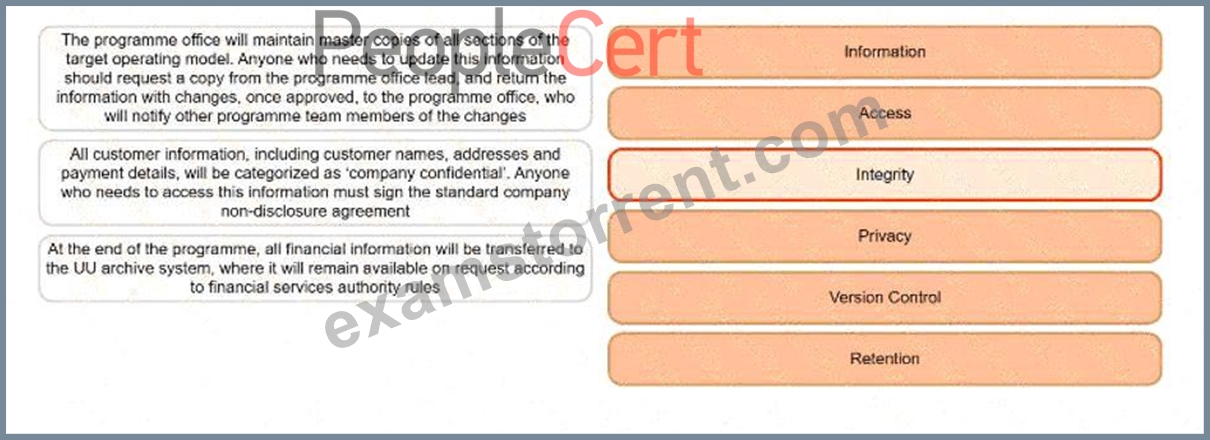
Answer:
Explanation: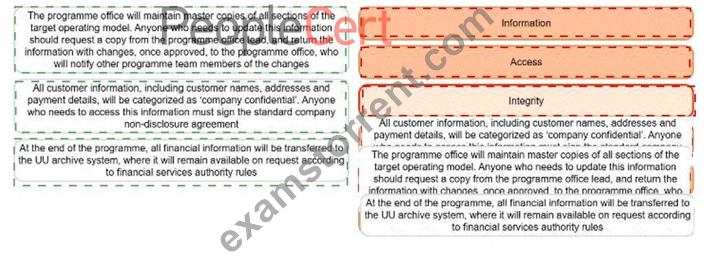
Explanation:
Information
Section
The programme office will maintain master copies of all sections of the TOM. Requests for updates must be approved before being notified to the team Version Control All customer information... will be categorized as 'company confidential'. Anyone needing access must sign the standard company NDA Privacy At the end of the programme, all financial information will be transferred to the UU archive system...
available on request
Retention
Controlling master copies and approving updates is the definition of Version Control. Handling sensitive personal data and NDAs falls under Privacy. Archiving and long-term availability post-programme is the focus of Retention
NEW QUESTION # 45
In delivering the capability, who is responsible for aligning projects with benefits realization?
- A. None
- B. Programme Manager
- C. BCM
- D. Both
Answer: D
NEW QUESTION # 46
The programme is in the 'plan progressive delivery' process for the first time and the business case has been confirmed. The programme manager is now attempting to get commitment from the Call Centre Manager that they will provide the staff needed in Tranche 1.
Is this an appropriate application of the 'plan progressive delivery' process, and why?
- A. Yes, because resources from the call centres will be critical to the success of Tranche 1
- B. No, because resources should be appointed by the project management team when Tranche 1 begins
- C. No, because the sponsoring group should commit the resources before Tranche 1 begins
- D. Yes, because the Call Centre Manager should commit the resources before Tranche 1 begins
Answer: D
Explanation:
Comprehensive and Detailed 200 to 250 words of Explanation From Exact Extract of project- programme-and-portfolio-management of 5th Edition MSP:
The 'Plan progressive delivery' process is the stage where the programme moves from high-level concepts to tangible, resourced plans. A key requirement of this process is to ensure that the resources (people, assets, and funding) required for the first tranche are not just identified, but actually committed by the business owners.
Option A is the correct answer. According to MSP 5th Edition, a programme should not proceed into a delivery tranche (such as Tranche 1) until there is a firm commitment from the functional managers who
"own" the resources. The Call Centre Manager is the person who must balance the needs of the programme against the needs of business-as-usual (BAU). If they do not commit the staff during the planning process, the programme risks failing in its first tranche due to resource shortages. The Sponsoring Group (Option C) provides the high-level mandate and funding, but the actual day-to-day commitment of staff must come from the operational line managers. This commitment is a prerequisite for the SRO to "Agree to proceed." Obtaining this commitment early is a critical success factor for programme management, as it reduces the risk of conflict between the programme and the business once delivery starts.
NEW QUESTION # 47
Which of the following is NOT normally a characteristic of the Vision Statement?
- A. It is short
- B. It must describe a desirable future
- C. Key benefits are implicit
- D. It must be time dependent
Answer: D
Explanation:
A Vision Statement is a succinct and compelling description of the desirable future state that the programme aims to achieve. It serves to inspire and align stakeholders around the intended outcomes and benefits. The MSP Practitioner outlines key characteristics of a Vision Statement, including that it must describe a desirable future and be concise to ensure clarity and focus.
Key benefits are often implicit within the Vision, providing a motivational overview without delving into detailed measurement or timelines.
However, the Vision Statement is NOT normally time-dependent. Time frames and milestones are introduced later in the programme planning stages, such as in the Business Case or Programme Plan. The MSP Practitioner explains: "Vision statement does not include time frames until programme is time bound in nature," which means the Vision is more about 'what' will be achieved rather than 'when.' This approach allows the Vision to remain stable even if timeframes or specific project plans evolve. The focus remains on the transformational goal, providing a constant reference point as the programme adapts to challenges and changes.
Therefore, including time-dependence in the Vision Statement could unnecessarily constrain the programme's strategic focus or create misalignment if schedules shift.
NEW QUESTION # 48
Who is accountable for confirming programme closure?
- A. SRO
- B. Sponsoring group
- C. Programme Manager
- D. BCM
Answer: A
Explanation:
The Senior Responsible Owner (SRO) is accountable for confirming programme closure. This responsibility involves assessing whether the programme's Business Case objectives and benefits have been satisfactorily met or if the programme is no longer viable.
The MSP Practitioner states: "SRO will confirm programme closure if business case is satisfied or unviable." The SRO ensures that all closure criteria, including benefit realization, risk mitigation, and stakeholder expectations, are addressed before formally closing the programme.
While the Programme Manager manages the operational closure tasks and the Sponsoring Group provides governance oversight, ultimate closure accountability rests with the SRO to ensure a controlled and successful programme conclusion aligned to strategic goals.
The Business Change Manager (BCM) supports by confirming benefits status but does not hold closure authority.
This clarity in accountability prevents premature or inappropriate programme termination and ensures a thorough and accountable close-out process.
NEW QUESTION # 49
Which of following is part of critical benefits validation test?
- A. Accurate
- B. Availability
- C. Attribution
- D. Currency
Answer: C
NEW QUESTION # 50
Which of following is a key attribute for a SRO?
- A. Have access to and credibility with key stakeholders
- B. Should represent a relevant business area
- C. Good knowledge of project management approaches
- D. Have ongoing operational responsibilities
Answer: A
Explanation:
A key attribute for the Senior Responsible Owner (SRO) is having access to and credibility with key stakeholders because the SRO plays a pivotal role in stakeholder management and programme accountability.
The MSP Practitioner notes, "This attribute is necessary as SRO is also involved in stakeholder management," emphasizing that SRO's influence and stakeholder credibility are critical to programme success.
NEW QUESTION # 51
Which of the following will not be in Issue register?
- A. Date issue was raised
- B. How issues will be identified, captured and assessed
- C. Description of issue
- D. Categorization of issue
Answer: B
Explanation:
The process of how issues will be identified, captured, and assessed is not recorded in the Issue Register itself but is instead documented in the Issue Management Strategy.
The MSP Practitioner clarifies: "How to deal with issue is identified in issue management strategy," meaning the register contains actual issues with details such as date raised, description, and categorization but not the procedural approach.
This distinction ensures that the register remains a real-time log of current issues while the management strategy defines policies and processes for consistent issue handling across the programme.
Maintaining this separation improves clarity and operational efficiency in issue management.
NEW QUESTION # 52
......
Peoplecert MSP-Practitioner Exam Syllabus Topics:
| Topic | Details |
|---|---|
| Topic 1 |
|
| Topic 2 |
|
| Topic 3 |
|
| Topic 4 |
|
| Topic 5 |
|
| Topic 6 |
|
Latest Questions MSP-Practitioner Guide to Prepare Free Practice Tests: https://pass4sure.examstorrent.com/MSP-Practitioner-exam-dumps-torrent.html