


C_ABAPD_2309 Premium Files Updated Dec-2024 Practice Valid Exam Dumps Question
Practice with C_ABAPD_2309 Dumps for SAP Certified Associate Certified Exam Questions & Answer
NEW QUESTION # 10
What are some properties of database tables? Note: There are 2 correct answers to this question.
- A. They store information in two dimensions.
- B. They can have any number of key fields.
- C. They may have key fields.
- D. They can have relationships to other tables.
Answer: A,D
Explanation:
Database tables are data structures that store information in two dimensions, using rows and columns. Each row represents a record or an entity, and each column represents an attribute or a field. Database tables may have key fields, which are columns that uniquely identify each row or a subset of rows. Key fields can be used to enforce data integrity, perform efficient searches, and establish relationships to other tables. Database tables can have relationships to other tables, which are associations or links between the key fields of two or more tables. Relationships can be used to model the logical connections between different entities, join data from multiple tables, and enforce referential integrity12.
NEW QUESTION # 11 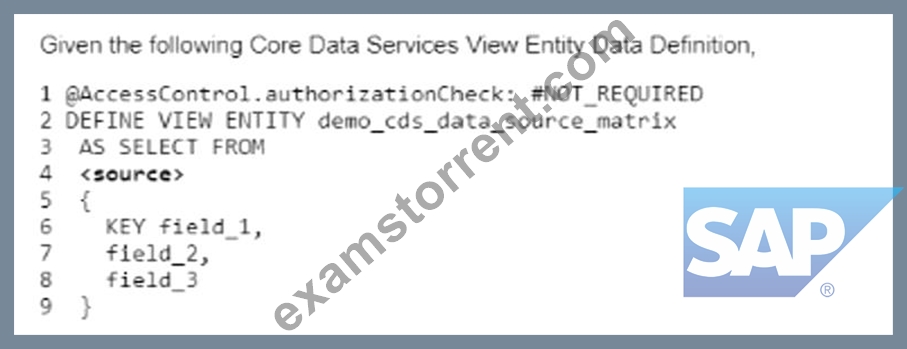
Which of the following types are permitted to be used for <source> on line #4? Note: There are 2 correct answers to this question.
- A. A CDS DDIC-based view
- B. A database table from the ABAP Dictionary
- C. An external view from the ABAP Dictionary
- D. A database view from the ABAP Dictionary
Answer: A,B
Explanation:
The <source> clause in the CDS View Entity Data Definition can be used to specify the data source for the view entity. The <source> clause can accept different types of data sources, depending on the type of the view entity1.
* A database table from the ABAP Dictionary: This is a valid type of data source for a CDS View Entity Data Definition. A database table from the ABAP Dictionary is a table that is defined in the ABAP Dictionary using the keyword TABLE or TABLE OF. The name of the database table must be unique within its namespace and must not contain any special characters2.
* A CDS DDIC-based view: This is also a valid type of data source for a CDS View Entity Data Definition. A CDS DDIC-based view is a view that is defined in the Core Data Services using the keyword DEFINE VIEW ENTITY. The name of the CDS DDIC-based view must be unique within its namespace and must not contain any special characters3.
You cannot do any of the following:
* An external view from the ABAP Dictionary: This is not a valid type of data source for a CDS View Entity Data Definition. An external view from the ABAP Dictionary is a view that is defined in an
* external application using any language supported by SAP, such as SQL, PL/SQL, or Java. The name of the external view must be unique within its namespace and must not contain any special characters4.
* A database view from the ABAP Dictionary: This is not a valid type of data source for a CDS View Entity Data Definition. A database view from the ABAP Dictionary is a view that is defined in an external application using any language supported by SAP, such as SQL, PL/SQL, or Java. The name of the database view must be unique within its namespace and must not contain any special characters4.
References: 1: CDS DDL - DEFINE VIEW ENTITY - ABAP Keyword Documentation - SAP Online Help 2:
ABAP Dictionary Tables - SAP Online Help 3: CDS DDL - DEFINE VIEW ENTITY - ABAP Keyword Documentation - SAP Online Help 4: ABAP Dictionary Views - SAP Online Help
NEW QUESTION # 12
Exhibit: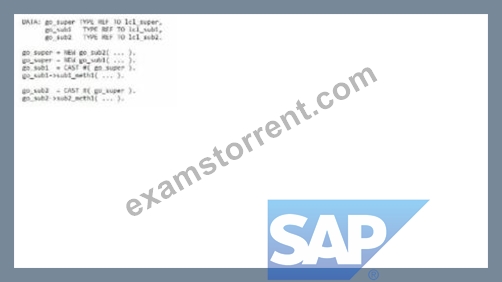
With Icl_super being superclass for Icl_subl and Icl_sub2 and with methods subl_methl and sub2_methl being subclass-specific methods of Id_subl or Icl_sub2, respectivel. What will happen when executing these casts? Note:
There are 2 correct answers to this question
- A. go_sub2 = CAST #(go_super). will not work. ] go sub2->sub2 meth 1(...). will work
- B. go_sub2 = CAST # go super), will work. go_subl CAST #go_super), will work
- C. go_subl->subl_meth !(...)* w'll work.
- D. go subl = CAST # go super), will not work
Answer: C,D
Explanation:
The following are the explanations for each statement:
A: This statement is correct. go_subl = CAST #(go_super) will not work. This is because go_subl is a data object of type REF TO cl_subl, which is a reference to the subclass cl_subl. go_super is a data object of type REF TO cl_super, which is a reference to the superclass cl_super. The CAST operator is used to perform a downcast or an upcast of a reference variable to another reference variable of a compatible type. A downcast is a conversion from a more general type to a more specific type, while an upcast is a conversion from a more specific type to a more general type. In this case, the CAST operator is trying to perform a downcast from go_super to go_subl, but this is not possible, as go_super is not pointing to an instance of cl_subl, but to an instance of cl_super. Therefore, the CAST operator will raise an exception CX_SY_MOVE_CAST_ERROR at runtime12 B: This statement is incorrect. go_sub2 = CAST #(go_super) will work. go_subl = CAST #(go_super) will not work. This is because go_sub2 is a data object of type REF TO cl_sub2, which is a reference to the subclass cl_sub2. go_super is a data object of type REF TO cl_super, which is a reference to the superclass cl_super. The CAST operator is used to perform a downcast or an upcast of a reference variable to another reference variable of a compatible type. A downcast is a conversion from a more general type to a more specific type, while an upcast is a conversion from a more specific type to a more general type. In this case, the CAST operator is trying to perform a downcast from go_super to go_sub2, and this is possible, as go_super is pointing to an instance of cl_sub2, which is a subclass of cl_super. Therefore, the CAST operator will assign the reference of go_super to go_sub2 without raising an exception. However, the CAST operator will not work for go_subl, as explained in statement A12 C: This statement is incorrect. go_sub2 = CAST #(go_super) will work. go_sub2->sub2_meth1(...) will not work. This is because go_sub2 is a data object of type REF TO cl_sub2, which is a reference to the subclass cl_sub2. go_super is a data object of type REF TO cl_super, which is a reference to the superclass cl_super. The CAST operator is used to perform a downcast or an upcast of a reference variable to another reference variable of a compatible type. A downcast is a conversion from a more general type to a more specific type, while an upcast is a conversion from a more specific type to a more general type. In this case, the CAST operator is trying to perform a downcast from go_super to go_sub2, and this is possible, as go_super is pointing to an instance of cl_sub2, which is a subclass of cl_super. Therefore, the CAST operator will assign the reference of go_super to go_sub2 without raising an exception. However, the method call go_sub2->sub2_meth1(...) will not work, as sub2_meth1 is a subclass-specific method of cl_sub2, which is not inherited by cl_super. Therefore, the method call will raise an exception CX_SY_DYN_CALL_ILLEGAL_METHOD at runtime123 D: This statement is correct. go_subl->subl_meth1(...) will work. This is because go_subl is a data object of type REF TO cl_subl, which is a reference to the subclass cl_subl. subl_meth1 is a subclass-specific method of cl_subl, which is not inherited by cl_super. Therefore, the method call go_subl->subl_meth1(...) will work, as go_subl is pointing to an instance of cl_subl, which has the method subl_meth1123
NEW QUESTION # 13
Exhibit: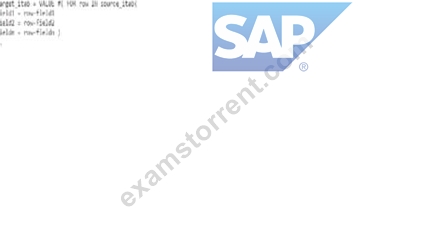
Which of the following statements are correct? Note: There are 2 correct answers to this question.
- A. row is a predefined name and cannot be chosen arbitrarily.
- B. row is only visible within the loop.
- C. source_itab is only visible within the loop.
- D. FOR defines a loop that runs over the content of source_itab
Answer: B,D
Explanation:
Explanation
The code snippet in the image is an example of using the FOR statement to create an internal table with a constructor expression. The FOR statement introduces an iteration expression that runs over the content of source_itab and assigns each row to the variable row. The variable row is then used to populate the fields of target_itab12. Some of the correct statements about the code snippet are:
FOR defines a loop that runs over the content of source_itab: This is true. The FOR statement iterates over the rows of source_itab and assigns each row to the variable row. The iteration expression can also specify a range or a condition for the loop12.
row is only visible within the loop: This is true. The variable row is a local variable that is only visible within the scope of the iteration expression. It cannot be accessed outside the loop12.
You cannot do any of the following:
source_itab is only visible within the loop: This is false. The variable source_itab is not a local variable that is defined by the FOR statement. It is an existing internal table that is used as the data source for the iteration expression. It can be accessed outside the loop12.
row is a predefined name and cannot be chosen arbitrarily: This is false. The variable row is not a predefined name that is reserved by the FOR statement. It is a user-defined name that can be chosen arbitrarily. However, it must not conflict with any existing names in the program12.
References: 1: FOR - Iteration Expressions - ABAP Keyword Documentation - SAP Online Help 2: ABAP 7.4 Syntax - FOR Loop iteration | SAP Community
NEW QUESTION # 14
Exhibit: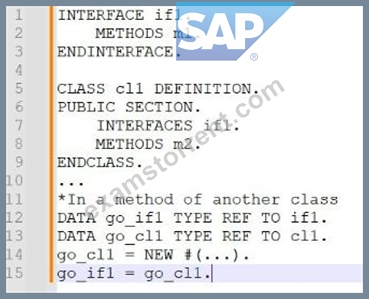
What are valid statements? Note: There are 3 correct answers to this question.
- A. Instead of go ell = NEW #(...) you could use go ifl = NEW cll(. ... ).
- B. Instead of go_cll = NEW #() you could use go_iff - NEW #(...).
- C. go_cll may call method ml with go_dl->ifl-ml().
- D. go_ifl may call method m2 with go if->m2(...).
- E. go_if 1 may call method ml with go_ift->ml().
Answer: A,D,E
Explanation:
The following are the explanations for each statement:
A: This statement is valid. go_ifl may call method ml with go_ifl->ml(). This is because go_ifl is a data object of type REF TO ifl, which is a reference to the interface ifl. The interface ifl defines a method ml, which can be called using the reference variable go_ifl. The class cll implements the interface ifl, which means that it provides an implementation of the method ml. The data object go_ifl is assigned to a new instance of the class cll using the NEW operator and the inline declaration operator @DATA. Therefore, when go_ifl->ml() is called, the implementation of the method ml in the class cll is executed123 B: This statement is valid. Instead of go_cll = NEW #(...) you could use go_ifl = NEW cll(...). This is because go_ifl is a data object of type REF TO ifl, which is a reference to the interface ifl. The class cll implements the interface ifl, which means that it is compatible with the interface ifl. Therefore, go_ifl can be assigned to a new instance of the class cll using the NEW operator and the class name cll. The inline declaration operator @DATA is optional in this case, as go_ifl is already declared. The parentheses after the class name cll can be used to pass parameters to the constructor of the class cll, if any123 E: This statement is valid. go_ifl may call method m2 with go_ifl->m2(...). This is because go_ifl is a data object of type REF TO ifl, which is a reference to the interface ifl. The class cll implements the interface ifl, which means that it inherits all the components of the interface ifl. The class cll also defines a method m2, which is a public method of the class cll. Therefore, go_ifl can call the method m2 using the reference variable go_ifl. The method m2 is not defined in the interface ifl, but it is accessible through the interface ifl, as the interface ifl is implemented by the class cll. The parentheses after the method name m2 can be used to pass parameters to the method m2, if any123 The other statements are not valid, as they have syntax errors or logical errors. These statements are:
C: This statement is not valid. go_cll may call method ml with go_cll->ifl~ml(). This is because go_cll is a data object of type REF TO cll, which is a reference to the class cll. The class cll implements the interface ifl, which means that it inherits all the components of the interface ifl. The interface ifl defines a method ml, which can be called using the reference variable go_cll. However, the syntax for calling an interface method using a class reference is go_cll->ml(), not go_cll->ifl~ml(). The interface component selector ~ is only used when calling an interface method using an interface reference, such as go_ifl->ifl~ml(). Using the interface component selector ~ with a class reference will cause a syntax error123 D: This statement is not valid. Instead of go_cll = NEW #() you could use go_ifl = NEW #(...). This is because go_ifl is a data object of type REF TO ifl, which is a reference to the interface ifl. The interface ifl cannot be instantiated, as it does not have an implementation. Therefore, go_ifl cannot be assigned to a new instance of the interface ifl using the NEW operator and the inline declaration operator @DATA. This will cause a syntax error or a runtime error. To instantiate an interface, you need to use a class that implements the interface, such as the class cll123
NEW QUESTION # 15
Which of the following are ABAP Cloud Development Model rules?
Note: There are 2 correct answers to this question.
- A. Build ABAP reports with either ABAP List Viewer (ALV) or SAP Fiori.
- B. Build ABAP RESTful application programming model-based services.
- C. Reverse modifications when a suitable public SAP API becomes available.
- D. Use public SAP APIs and SAP extension points.
Answer: C,D
Explanation:
* Use public SAP APIs and SAP extension points. This rule ensures that the ABAP Cloud code is stable, reliable, and compatible with the SAP solutions and the cloud operations. Public SAP APIs and SAP extension points are the only allowed interfaces and objects to access the SAP platform and the SAP applications. They are documented, tested, and supported by SAP. They also guarantee the lifecycle stability and the upgradeability of the ABAP Cloud code1.
* Build ABAP RESTful application programming model-based services. This rule ensures that the ABAP Cloud code follows the state-of-the-art development paradigm for building cloud-ready business services. The ABAP RESTful application programming model (RAP) is a framework that provides a consistent end-to-end programming model for creating, reading, updating, and deleting (CRUD) business data. RAP also supports draft handling, authorization checks, side effects, validations, and custom actions. RAP exposes the business services as OData services that can be consumed by SAP Fiori apps or other clients2.
NEW QUESTION # 16 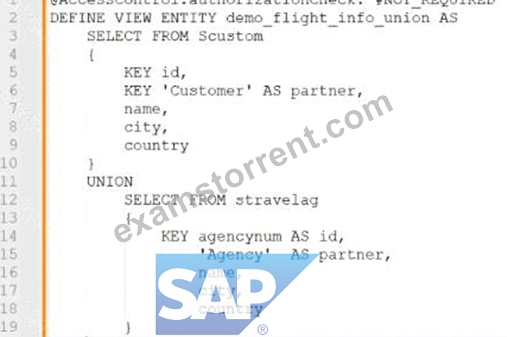
when you attempt to activate the definition, what will be the response?
- A. Activation error because the key fields of the union do not match
- B. Activation error because the field types of the union do not match
- C. Activation successful
- D. Activation error because the field names of the union do not match
Answer: D
Explanation:
The response will be an activation error because the field names of the union do not match. This is because the field names of the union must match in order for the definition to be activated. The union operator combines the result sets of two or more queries into a single result set. The queries that are joined by the union operator must have the same number and type of fields, and the fields must have the same names1. In the given code, the field names of the union do not match, because the first query has the fields carrname, connid, cityfrom, and cityto, while the second query has the fields carrname, carrier_id, cityfrom, and cityto. The field connid in the first query does not match the field carrier_id in the second query. Therefore, the definition cannot be activated.
References: 1: UNION - ABAP Keyword Documentation
NEW QUESTION # 17
Exhibit:
With Icl_super being superclass for Icl_subl and Icl_sub2 and with methods subl_methl and sub2_methl being subclass-specific methods of Id_subl or Icl_sub2, respectivel. What will happen when executing these casts?
Note:
There are 2 correct answers to this question
- A. go_sub2 = CAST #(go_super). will not work. ] go sub2->sub2 meth 1(...). will work
- B. go_sub2 = CAST # go super), will work. go_subl CAST #go_super), will work
- C. go_subl->subl_meth !(...)* w'll work.
- D. go subl = CAST # go super), will not work
Answer: C,D
Explanation:
Explanation
The following are the explanations for each statement:
A: This statement is correct. go_subl = CAST #(go_super) will not work. This is because go_subl is a data object of type REF TO cl_subl, which is a reference to the subclass cl_subl. go_super is a data object of type REF TO cl_super, which is a reference to the superclass cl_super. The CAST operator is used to perform a downcast or an upcast of a reference variable to another reference variable of a compatible type. A downcast is a conversion from a more general type to a more specific type, while an upcast is a conversion from a more specific type to a more general type. In this case, the CAST operator is trying to perform a downcast from go_super to go_subl, but this is not possible, as go_super is not pointing to an instance of cl_subl, but to an instance of cl_super. Therefore, the CAST operator will raise an exception CX_SY_MOVE_CAST_ERROR at runtime12 B: This statement is incorrect. go_sub2 = CAST #(go_super) will work. go_subl = CAST #(go_super) will not work. This is because go_sub2 is a data object of type REF TO cl_sub2, which is a reference to the subclass cl_sub2. go_super is a data object of type REF TO cl_super, which is a reference to the superclass cl_super. The CAST operator is used to perform a downcast or an upcast of a reference variable to another reference variable of a compatible type. A downcast is a conversion from a more general type to a more specific type, while an upcast is a conversion from a more specific type to a more general type. In this case, the CAST operator is trying to perform a downcast from go_super to go_sub2, and this is possible, as go_super is pointing to an instance of cl_sub2, which is a subclass of cl_super.
Therefore, the CAST operator will assign the reference of go_super to go_sub2 without raising an exception. However, the CAST operator will not work for go_subl, as explained in statement A12 C: This statement is incorrect. go_sub2 = CAST #(go_super) will work. go_sub2->sub2_meth1(...) will not work. This is because go_sub2 is a data object of type REF TO cl_sub2, which is a reference to the subclass cl_sub2. go_super is a data object of type REF TO cl_super, which is a reference to the superclass cl_super. The CAST operator is used to perform a downcast or an upcast of a reference variable to another reference variable of a compatible type. A downcast is a conversion from a more general type to a more specific type, while an upcast is a conversion from a more specific type to a more general type. In this case, the CAST operator is trying to perform a downcast from go_super to go_sub2, and this is possible, as go_super is pointing to an instance of cl_sub2, which is a subclass of cl_super.
Therefore, the CAST operator will assign the reference of go_super to go_sub2 without raising an exception. However, the method call go_sub2->sub2_meth1(...) will not work, as sub2_meth1 is a subclass-specific method of cl_sub2, which is not inherited by cl_super. Therefore, the method call will raise an exception CX_SY_DYN_CALL_ILLEGAL_METHOD at runtime123 D: This statement is correct. go_subl->subl_meth1(...) will work. This is because go_subl is a data object of type REF TO cl_subl, which is a reference to the subclass cl_subl. subl_meth1 is a subclass-specific method of cl_subl, which is not inherited by cl_super. Therefore, the method call go_subl->subl_meth1(...) will work, as go_subl is pointing to an instance of cl_subl, which has the method subl_meth1123 References: NEW - ABAP Keyword Documentation, CAST - ABAP Keyword Documentation, Method Call - ABAP Keyword Documentation
NEW QUESTION # 18
Why would you use Access Controls with CDS Views? Note: There are 2 correct answers to this question.
- A. You do not have to remember to implement AUTHORITY CHECK statements.
- B. The system field sy-subrc is set, giving you the result of the authorization check
- C. Only the data corresponding to the user's authorization is transferred from the database to the application layer.
- D. All of the data from the data sources is loaded into your application automatically and filtered there according to the user's authorization.
Answer: A,C
Explanation:
Explanation
You would use Access Controls with CDS Views for the following reasons:
A). Only the data corresponding to the user's authorization is transferred from the database to the application layer. This is true because Access Controls allow you to define CDS roles that specify the authorization conditions for accessing a CDS view. The CDS roles are evaluated for every user at runtime and the system automatically adds the restrictions to the selection conditions of the CDS view.
This ensures that only the data that the user is authorized to see is read from the database and transferred to the application layer. This improves the security and the performance of the data access1.
C). You do not have to remember to implement AUTHORITY CHECK statements. This is true because Access Controls provide a declarative and centralized way of defining the authorization logic for a CDS view. You do not have to write any procedural code or use the AUTHORITY CHECK statement to check the user's authorization for each data source or field. The system handles the authorization check automatically and transparently for you2.
The following reasons are not valid for using Access Controls with CDS Views:
B). The system field sy-subrc is set, giving you the result of the authorization check. This is false because the system field sy-subrc is not used by Access Controls. The sy-subrc field is used by the AUTHORITY CHECK statement to indicate the result of the authorization check, but Access Controls do not use this statement. Instead, Access Controls use CDS roles to filter the data according to the user's authorization2.
D). All of the data from the data sources is loaded into your application automatically and filtered there according to the user's authorization. This is false because Access Controls do not load all the data from the data sources into the application layer. Access Controls filter the data at the database layer, where the data resides, and only transfer the data that the user is authorized to see to the application layer. This reduces the data transfer and the memory consumption of the application layer1.
References: 1: Access Controls | SAP Help Portal 2: ABAP CDS - Access Control - ABAP Keyword Documentation
NEW QUESTION # 19
Exhibit
Which of the following ABAP SQL snippets are syntactically correct ways to provide a value for the parameter on line #4? Note: There are 2 correct answers to this question
- A. ...SELECT * FROM demo_cds_param_view_entity (p_date: 20238181')... )
- B. ...SELECT * FROM deno_cds_param_view_entity (p_date = @
(cl_abap_context_info->get_system_date ())... - C. ...SELECT * FROM deno_cds_param_view_entity (p_date - '20230101')... )
- D. ...SELECT * FROM demo_cds_param_view entity (p_date: $session.system_date)...
Answer: B,C
NEW QUESTION # 20
Which of the following is a generic internal table type?
- A. STANDARD TABLE
- B. SORTED TABLE
- C. INDEX TABLE
- D. HASHED TABLE
Answer: C
Explanation:
Explanation
A generic internal table type is a table type that does not define all the attributes of an internal table in the ABAP Dictionary; it leaves some of these attributes undefined. A table type is generic in the following cases1:
You have selected Index Table or Not Specified as the access type.
You have not specified a table key or specified an incomplete table key.
You have specified a generic secondary table key.
A generic table type can be used only for typing formal parameters or field symbols. A generic table type cannot be used for defining data objects or constants2.
Therefore, the correct answer is B. INDEX TABLE, which is a generic table type that does not specify the access type or the table key. The other options are not generic table types, because:
A: SORTED TABLE is a table type that specifies the access type as sorted and the table key as a unique or non-unique primary key3.
C: STANDARD TABLE is a table type that specifies the access type as standard and the table key as a non-unique standard key that consists of all the fields of the table row in the order in which they are defined4.
D: HASHED TABLE is a table type that specifies the access type as hashed and the table key as a unique primary key5.
References: 1: Generic Table Types - ABAP Dictionary - SAP Online Help 2: Generic ABAP Types - ABAP Keyword Documentation - SAP Online Help 3: Sorted Tables - ABAP Keyword Documentation - SAP Online Help 4: Standard Tables - ABAP Keyword Documentation - SAP Online Help 5: Hashed Tables - ABAP Keyword Documentation - SAP Online Help
NEW QUESTION # 21
You have a superclass superl and a subclass subl of superl. Each class has an instance constructor and a static constructor. The first statement of your program creates an instance of subl. In which sequence will the constructors be executed?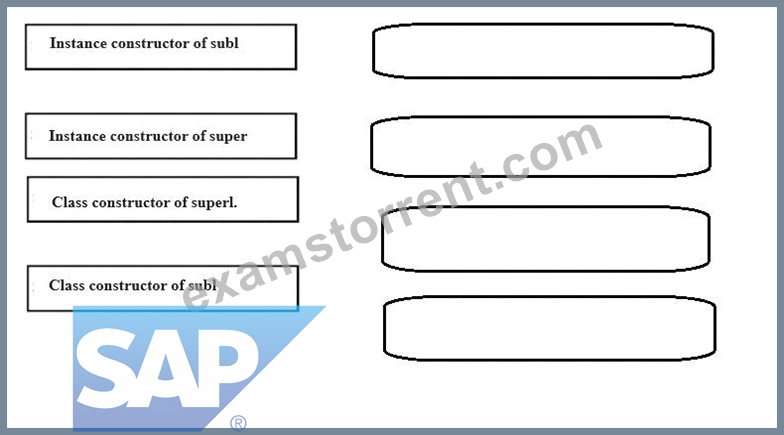
Answer:
Explanation: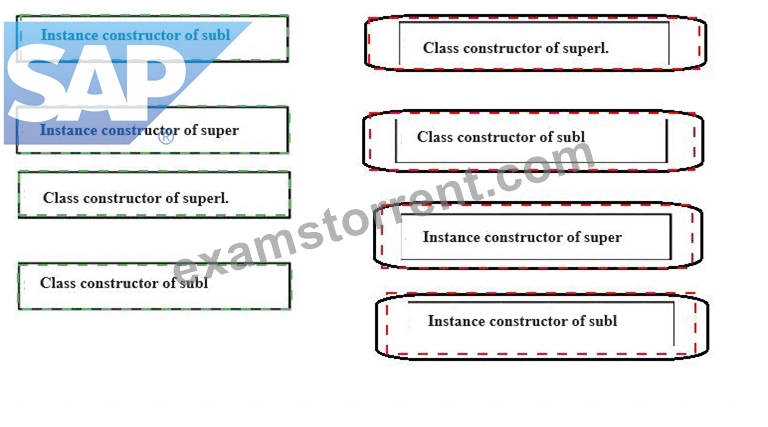
Explanation:
The sequence in which the constructors will be executed is as follows:
* Class constructor of superl. This is because the class constructor is a static method that is executed automatically before the class is accessed for the first time. The class constructor is used to initialize the static attributes and components of the class. The class constructor of the superclass is executed before the class constructor of the subclass, as the subclass inherits the static components of the superclass12
* Class constructor of subl. This is because the class constructor is a static method that is executed automatically before the class is accessed for the first time. The class constructor is used to initialize the static attributes and components of the class. The class constructor of the subclass is executed after the class constructor of the superclass, as the subclass inherits the static components of the superclass12
* Instance constructor of superl. This is because the instance constructor is an instance method that is executed automatically when an instance of the class is created using the statement CREATE OBJECT.
The instance constructor is used to initialize the instance attributes and components of the class. The instance constructor of the superclass is executed before the instance constructor of the subclass, as the subclass inherits the instance components of the superclass. The instance constructor of the subclass must call the instance constructor of the superclass explicitly using super->constructor, unless the superclass is the root node object12
* Instance constructor of subl. This is because the instance constructor is an instance method that is executed automatically when an instance of the class is created using the statement CREATE OBJECT.
The instance constructor is used to initialize the instance attributes and components of the class. The instance constructor of the subclass is executed after the instance constructor of the superclass, as the subclass inherits the instance components of the superclass. The instance constructor of the subclass must call the instance constructor of the superclass explicitly using super->constructor, unless the superclass is the root node object12 References: Constructors of Classes - ABAP Keyword Documentation, METHODS - constructor - ABAP Keyword Documentation
NEW QUESTION # 22 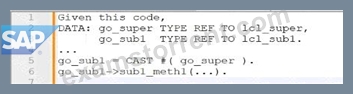
with which predicate condition can you ensure that the CAST will work?
- A. IS NOT INITIAL
- B. IS SUPPLIED
- C. IS BOUND
- D. IS INSTANCE OF
Answer: D
Explanation:
The predicate condition that can be used to ensure that the CAST will work is IS INSTANCE OF. The IS INSTANCE OF predicate condition checks whether the operand is an instance of the specified class or interface. This is useful when you want to perform a downcast, which is a conversion from a more general type to a more specific type. A downcast can fail if the operand is not an instance of the target type, and this can cause a runtime error. Therefore, you can use the IS INSTANCE OF predicate condition to check whether the downcast is possible before using the CAST operator12. For example:
* The following code snippet uses the IS INSTANCE OF predicate condition to check whether the variable g_super is an instance of the class lcl_super. If it is, the CAST will work and the variable g_sub1 will be assigned the value of g_super.
DATA: g_super TYPE REF TO lcl_super, g_sub1 TYPE REF TO lcl_sub1. IF g_super IS INSTANCE OF lcl_super. g_sub1 = CAST #( g_super ). g_sub1->method( ... ). ENDIF.
You cannot do any of the following:
* IS SUPPLIED: The IS SUPPLIED predicate condition checks whether an optional parameter of a method or a function module has been supplied by the caller. This is useful when you want to handle different cases depending on whether the parameter has a value or not. However, this predicate condition has nothing to do with the CAST operator or the type of the operand12.
* IS NOT INITIAL: The IS NOT INITIAL predicate condition checks whether the operand has a non-initial value. This is useful when you want to check whether the operand has been assigned a value or not. However, this predicate condition does not guarantee that the CAST will work, because the operand may have a value but not be an instance of the target type12.
* IS BOUND: The IS BOUND predicate condition checks whether the operand is a bound reference variable. This is useful when you want to check whether the operand points to an existing object or not. However, this predicate condition does not guarantee that the CAST will work, because the operand may point to an object but not be an instance of the target type12.
References: 1: Predicate Expressions - ABAP Keyword Documentation - SAP Online Help 2: ABAP - Predicates | SAP Community
NEW QUESTION # 23
In RESTful Application Programming, which EML statement retrieves an object?
- A. Select entity
- B. Find entity
- C. Get entity
- D. Read entity
Answer: C
Explanation:
In RESTful Application Programming, the EML statement that retrieves an object is GET entity. The GET entity statement is used to read data of an entity instance from the database or the transaction buffer. The GET entity statement can specify the entity name, the entity key, and the entity elements to be retrieved. The GET entity statement can also use the IN LOCAL MODE addition to bypass the access control, authorization control, and feature control checks. The GET entity statement returns a single entity instance or raises an exception if no instance is found or multiple instances match the key.
The other EML statements are not used to retrieve an object, but have different purposes and effects. These statements are:
FIND entity: This statement is used to search for entity instances that match a given condition. The FIND entity statement can specify the entity name, the entity elements to be returned, and the condition to be applied. The FIND entity statement can also use the IN LOCAL MODE addition to bypass the access control, authorization control, and feature control checks. The FIND entity statement returns a table of entity instances or an empty table if no instances match the condition.
SELECT entity: This statement is used to query data of entity instances from the database or the transaction buffer. The SELECT entity statement can specify the entity name, the entity elements to be returned, and the filter, order, and aggregation options to be applied. The SELECT entity statement can also use the IN LOCAL MODE addition to bypass the access control, authorization control, and feature control checks. The SELECT entity statement returns a table of entity instances or an empty table if no instances match the query.
READ entity: This statement is not a valid EML statement, but an ABAP statement. The READ statement is used to access a single row of an internal table using the table index or the table key. The READ statement can also use the TRANSPORTING addition to specify which fields should be returned, and the INTO addition to specify the target variable. The READ statement returns a single row of the internal table or raises an exception if no row is found or multiple rows match the key.
NEW QUESTION # 24
What are some of the reasons that Core Data Services are preferable to the classical approach to data modeling? Note: There are 2 correct answers to this question.
- A. They avoid data transfer completely.
- B. They transfer computational results to the application server.
- C. They compute results on the application server.
- D. They implement code pushdown.
Answer: B,D
Explanation:
Explanation
Core Data Services (CDS) are preferable to the classical approach to data modeling for several reasons, but two of them are:
They implement code pushdown. Code pushdown is the principle of moving data-intensive logic from the application server to the database server, where the data resides. This reduces the data transfer between the application server and the database server, which improves the performance and scalability of the application. CDS enable code pushdown by allowing the definition of semantic data models and business logic in the database layer, using SQL and SQL-based expressions1.
They transfer computational results to the application server. CDS allow the application server to access the data and the logic defined in the database layer by using Open SQL statements. Open SQL is a standardized and simplified subset of SQL that can be used across different database platforms. Open SQL statements are translated into native SQL statements by the ABAP runtime environment and executed on the database server. The results of the computation are then transferred to the application server, where they can be further processed or displayed2.
References: 1: ABAP - Core Data Services (ABAP CDS) - ABAP Keyword Documentation 2: Open SQL - ABAP Keyword Documentation
NEW QUESTION # 25
You have two internal tables itab1 and itab2.What is true for using the expression itab1 = corresponding #( itab2 )? Note: There are 2 correct answers to this question.
- A. itab1 and itab2 must have at least one field name in common.
- B. itab1 and itab2 must have the same data type.
- C. Fields with the same name and the same type will be copied from itab2 to itab1.
- D. Fields with the same name but with different types may be copied from itab2 to itab1.
Answer: A,C
Explanation:
The expression itab1 = corresponding #( itab2 ) is a constructor expression with the component operator CORRESPONDING that assigns the contents of the internal table itab2 to the internal table itab1. The following statements are true for using this expression:
B: itab1 and itab2 must have at least one field name in common. This is because the component operator CORRESPONDING assigns the identically named columns of itab2 to the identically named columns of itab1 by default, according to the rules of MOVE-CORRESPONDING for internal tables. If itab1 and itab2 do not have any field name in common, the expression will not assign any value to itab1 and it will remain initial or unchanged1 C: Fields with the same name and the same type will be copied from itab2 to itab1. This is because the component operator CORRESPONDING assigns the identically named columns of itab2 to the identically named columns of itab1 by default, according to the rules of MOVE-CORRESPONDING for internal tables. If the columns have the same name but different types, the assignment will try to perform a conversion between the types, which may result in a loss of precision, a truncation, or a runtime error, depending on the types involved1 The following statements are false for using this expression:
A: Fields with the same name but with different types may be copied from itab2 to itab1. This is not true, as explained in statement C. The assignment will try to perform a conversion between the types, which may result in a loss of precision, a truncation, or a runtime error, depending on the types involved1 D: itab1 and itab2 must have the same data type. This is not true, as the component operator CORRESPONDING can assign the contents of an internal table of one type to another internal table of a different type, as long as they have at least one field name in common. The target type of the expression is determined by the left-hand side of the assignment, which is itab1 in this case. The expression will create an internal table of the same type as itab1 and assign it to itab11
NEW QUESTION # 26
......
SAP C_ABAPD_2309 Exam Syllabus Topics:
| Topic | Details |
|---|---|
| Topic 1 |
|
| Topic 2 |
|
| Topic 3 |
|
| Topic 4 |
|
| Topic 5 |
|
REAL C_ABAPD_2309 Exam Questions With 100% Refund Guarantee : https://pass4sure.examstorrent.com/C_ABAPD_2309-exam-dumps-torrent.html