


Prepare for your exam certification with our Salesforce-MuleSoft-Developer-I Certified Salesforce
Free Salesforce Salesforce-MuleSoft-Developer-I Exam 2025 Practice Materials Collection
NEW QUESTION # 115
Refer to the exhibit. The main flow contains an HTTP Request in the middle of the flow. The HTTP Listeners and HTTP request use default configurations.
What values are accessible to the Logger at the end of the flow after a web client submit request to http://local:801/order?color=red?
- A. payload quantity var
- B. payload color query param
- C. payload quantity var color query param
- D. payload
Answer: A
Explanation:
In this case as outbound call is made using HTTP: POST /child , all attributes will be replaced by this invocation. Hence query parameter will not be accessible at logger.
NEW QUESTION # 116
A Scatter-Gather processes three separate HTTP requests. Each request returns a Mule event with a JSON payload. What is the final output of the Scatter-Gather?
- A. An Object containing all three Mule event Objects
- B. An Object containing all three JSON payload Objects
- C. An Array of the three JSON payload Objects
- D. An Array of the three Mule event Objects
Answer: A
Explanation:
Correct answer is An Object containing all three Mule event Objects
The Scatter-Gather component is a routing event processor that processes a Mule event through different parallel processing routes that contain different event processors. Each route receives a reference to the Mule event and executes a sequence of one or more event processors. Each of these routes uses a separate thread to execute the event processors, and the resulting Mule event can be either the same Mule event without modifications or a new Mule event with its own payload, attributes, and variables. The Scatter-Gather component then combines the Mule events returned by each processing route into a new Mule event that is passed to the next event processor only after every route completes successfully.
The Scatter-Gather component executes each route in parallel, not sequentially. Parallel execution of routes can greatly increase the efficiency of your Mule application and may provide more information than sequential processing.
Sample output is as below
MuleSoft Documentation reference : https://docs.mulesoft.com/mule-runtime/4.3/scatter-gather-concept
NEW QUESTION # 117
A Mule project contains a MySQL Database dependency. The project is exported from Anypoint Studio so it can be deployed to CloudHub.
What export options create the smallest deployable archive that will successfully deploy to CloudHub?
What export option create their smallest deployable archive that will successfully deploy to CloudHub?
- A.

- B.

- C.

- D.

Answer: B
NEW QUESTION # 118
Refer to the exhibits.
The input array of strings is processed by the batch job that processes, filters, and aggregates the values. What is the last message logged by the Logger component after the batch job completes processing?
- A. [''D", "E"]
- B. [ "A", "C, "D", "E" ]
- C. [''E'']
- D. [ ["A", "C", "D" ], ["E"] ]
Answer: C
Explanation:
Logs would look like:
INFO 2021-06-09 19:14:56,039 [[MuleRuntime].uber.06: [validationtest].batch-job-validationtestBatch_Job-work-manager @6de10f3e] [processor: validationtestFlow/processors/1/route/0/route/0/aggregator/processors/0; event: bfb751e1-9939-11eb-9f69-02053763653a] org.mule.runtime.core.internal.processor.LoggerMessageProcessor:
[
"\"A\"",
"\"C\"",
"\"D\""
]
--
INFO 2021-06-09 19:15:02,486 [[MuleRuntime].uber.06: [validationtest].batch-job-validationtestBatch_Job-work-manager @6de10f3e] [processor: validationtestFlow/processors/1/route/0/route/0/aggregator/processors/0; event: bfb751e1-9939-11eb-9f69-02053763653a] org.mule.runtime.core.internal.processor.LoggerMessageProcessor: [
"\"E\""
]
Batch aggregator value is 3. Hence in first time it will print ["A", "C", "D"] and in next iteration it will print [ "E" ]
-------------------------------------------------------------------------------------------------------------------------------------------------- Correct answer is [ "E" ]
NEW QUESTION # 119
Refer to the exhibits.
The Set Payload transformer In the addltem subflow uses DataWeave to create an order object.
What is the correct DataWeave code for the Set Payload transformer in the createOrder flow to use the addltem subflow to add a router cable with the price of 100 to the order?
- A. addltemf { price: "100", item: "router", itemType: "cable" })
- B. addltemf { payload: { price: "100", item: "router", itemType: "cable" } > )
- C. lookupf "addltem", { price: "100", item: "router", itemType: "cable" } )
- D. lookupf "addltem", { payload: { price: "100", item: "router", itemType: "cable" } } )
Answer: D
NEW QUESTION # 120
Refer to the exhibits. A database Address table contains a ZIPCODE column and an increasing ID column. The Address table currently contains tour (4) records. The On Table Row Database listener is configured with its watermark set to the Address table's ZIPCODE column and then the Mule application is run in Anypoint Studio tor the first time, and the On Table Row Database listener polls the Address table.
Anew row is added to the database with 1D=5 and ZIPCODE-90006, and then the On Table Row Database listener polls the database again.
Alter the next execution of the On Table Row Database listener polling, what database rows have been processed by the Mule flow since the Mule application was started?
- A. ID ZIPCODE
1 90001
2 90005
3 90009 - B. ID ZIPCODE
1 90001
2 90005
3 90009
4 90001 - C. ID ZIPCODE
1 90001
2 90005
3 90009
4 90001 - D. ID ZIPCODE
1 90001
2 90005
3 90009
5 90006
Answer: B
Explanation:
5 90006
NEW QUESTION # 121
Refer to the exhibits.
What is the response when a client submits a request to http://localhost:8081?
- A. Before
- B. null
- C. Validation error
- D. After
Answer: C
Explanation:
----------------------------------------------------------------------------------------------------------------------------------- Here's specifically what is happening here:
1) Payload is successfully set to "Before"
2) Is null validation is used which will pass the message only if payload is null. In this case as payload is not null, it creates an Error Object. Flow execution stops
#[error.description] = "Validation error"
3) Because no error handler is defined, the Mule default error handler handles the error
4) "Validation error" is the error message returned to the requestor in the body of the HTTP request with HTTP Status Code: 500 Reference diagram:
NEW QUESTION # 122
Refer to the exhibits.

A web client submits a request to the HTTP Listener and the HTTP Request throws an error.
What payload and status code are returned to the web client?
Refer to the exhibits. A web client submits a request to the HTTP Listener and the HTTP Request throws an error.
What payload and status code are returned to the web client?
- A. Response body: "Success - Begin* Default response status code: 200
- B. Error response body: error, description Default error response status code: 500
- C. Response body: "Error" Default response status code: 200
- D. Response body: "Success - End" Default response status code: 200
Answer: C
Explanation:
Correct Answer: Response body: "Error" Default response status code: 200.
-------------------------------------------------------------------------------------------------------------------------------------------------
1) Payload is successfully set to "Success - Started Flow"
2) When HTTP Request throws an error, execution halts
#[error.description] = "ABC"
#[error.errorType] = "XYZ"
3) The On Error Continue scope handles the error. When On Error Continue scope is invoked, all the processors in error block are executed and success response is sent back to the client with payload which is set in error flow. In this case payload is set to "Error" value in error block.
4) "Error" is returned to the requestor in the body of the HTTP request with HTTP Status Code: 200 as On error continue always sends success error code.
Reference Diagram:
NEW QUESTION # 123
Refer to the exhibit.
What can be added to the flow to persist data across different flow executions?
- A. Key/value pairs in the ObjectStore
- B. session variables
- C. properties of the Mule runtime app object
- D. Properties of the Mule runtime flow object
Answer: A
Explanation:
An object store is a facility for storing objects in or across Mule applications. Mule runtime engine (Mule) uses object stores to persist data for eventual retrieval. Internally, Mule uses object stores in various filters, routers, and other message processors that need to store states between messages.
Object stores are available in all deployment targets. If you deploy your application to CloudHub, you can also use Object Store V2.
Correct answer is Key/value pair in Object store
MuleSoft Documentation reference : https://docs.mulesoft.com/mule-runtime/4.3/mule-object-stores#use-cases
NEW QUESTION # 124
According to Mulesoft, how are Modern APIs treated as?
- A. Products
- B. SOAP API's
- C. Rest API's
- D. Code
Answer: A
Explanation:
Correct answer is Products
Modern API has three features 1) Treated as products for easy consumption 2) Discoverable and accessible through self-service 3) Easily managed for security , scalability and performance
NEW QUESTION # 125
Refer to the exhibits. The webClient flow sends requests to the mockServer Row's HTTP Listener.
An HTTP: METHOD_NOT ALLOWED error is thrown each time the webClient flow executes.
What attribute value must be changed in the webClient flow's HTTP Request operation to prevent this error from being thrown?
- A. Change the method attribute's value to "POSL
- B. Change the method attribute's value to "*"
- C. Change the protocol attribute's value to "HTTPS"
- D. Change the path attribute's value to 7api/partners/fastShopping"
Answer: A
NEW QUESTION # 126
A company has an API to manage departments, with each department identified by a unique deptld. The API was built with RAML according to MuleSoft best practices.
What is valid RAML to specify a method to update the details for a specific department?
- A.

- B.

- C.

- D.

Answer: C
Explanation:
URI parameter is basically used to identify a specific resource or resources
* Here we want to update details about specific department, so question is asking 'How to use URI parameter' in RAML
* Correct answer is
/departments:
/{deptId}:
patch:
NEW QUESTION # 127
Which Mule component provides a real-time, graphical representation of the APIs and mule applications that are running and discoverable?
- A. Runtime Manager
- B. Anypoint Visualizer
- C. API Notebook
- D. API Manager
Answer: B
Explanation:
Correct answer is Anypoint Visualizer
MuleSoft Doc Ref : https://docs.mulesoft.com/visualizer/
Anypoint Visualizer provides a real-time, graphical representation of the APIs, and Mule applications that are running and discoverable. It also displays third-party systems that are invoked by a Mule API, proxy, or application within your application network. The data displayed in the graph is dynamically updated and does not require prior configuration. Additionally, the data displayed is secure, as only users with the proper permissions can view the application network graph.
NEW QUESTION # 128
An API instance of type API endpoint with API proxy is created in API manager using an API specification from Anypoint Exchange. The API instance is also configured with an API proxy that is deployed and running in CloudHub.
An SLA- based policy is enabled in API manager for this API instance.
Where can an external API consumer obtain a valid client ID and client secret to successfully send requests to the API proxy?
- A. In Anypoint Studio, from components generated by Rest Connect for API specification
- B. In Runtime Manager, from the properties tab of the deployed approved API proxy
- C. In the organization's public API portal in Anypoint Exchange, from an approved client application for the API proxy
- D. In Anypoint Studio, from components generated by APIkit for the API specification
Answer: C
Explanation:
* When a client application is registered in Anypoint Platform, a pair of credentials consisting of a client ID and client secret is generated.
* When the client application requests access to an API, a contract is created between the application and that API.
* An API that is protected with a Client ID Enforcement policy is accessible only to applications that have an approved contract.
--------------------------------------------------------------------------------------------------------------------------------------------- Correct Answer: In the organization's public API portal in Anypoint Exchange, from
NEW QUESTION # 129
A web client submits a request to http://localhost:8081/books/0471767840. The value "0471767840" is captured by a Set Variable transformer to a variable named booklSBN.
What is the DataWeave expression to access booklSBN later in the flow?
- A. flowVars.booklSBN
- B. attributes.booklSBN
- C. vars. booklSBN
- D. booklSBN
Answer: C
NEW QUESTION # 130
Refer to the exhibits.
What is valid text to set the field in the Database connector configuration to the username value specified in the config.yaml file?
- A. #[db:username]
- B. ${db:username>
- C. ${db.username>
- D. #[db.username]
Answer: C
Explanation:
option 3 is the correct syntz to access application properties
NEW QUESTION # 131
A mule project contains MySQL database dependency . The project is exported from Anypoint Studio so that it can be deployed to Cloudhub. What export options needs to be selected to create the smallest deployable archive that will successfully deploy to Cloudhub?
- A. Select both the options 1) Attach project sources 2) Include project module and dependencies
- B. Select only below option 1) Attach project sources
- C. Select only below option 2) Include project module and dependencies
- D. No need to select any of the below options 1) Attach project sources 2) Include project module and dependencies
Answer: C
Explanation:
You can choose Attach Project Sources to include metadata that Studio requires to reimport the deployable file as an open Mule project into your workspace. You must keep the Attach Project Sources option selected to be able to import the packaged JAR file back into a Studio workspace. But requirement here is to create smallest deployable archive that will successfully deploy to Cloudhub. Hence we can ignore this option.
We need to select Include project module and dependencies
As actual modules and external dependencies required to run the Mule application in a Mule runtime engine Hence correct answer is Select only below option 2) Include project module and dependencies MuleSoft Doc Ref : https://docs.mulesoft.com/studio/7.5/import-export-packages#exporting-a-studio-project-to-a-deployable-mule-application
NEW QUESTION # 132
Refer to the exhibits. A company has defined this Book data type and Book example to be used in APIs. What is valid RAML for an API that uses this Book data type and Book example?
- A.
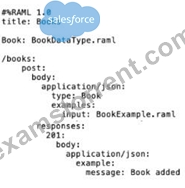
- B.

- C.

- D.

Answer: C
NEW QUESTION # 133
......
Pass Salesforce Salesforce-MuleSoft-Developer-I Actual Free Exam Q&As Updated Dump: https://pass4sure.examstorrent.com/Salesforce-MuleSoft-Developer-I-exam-dumps-torrent.html